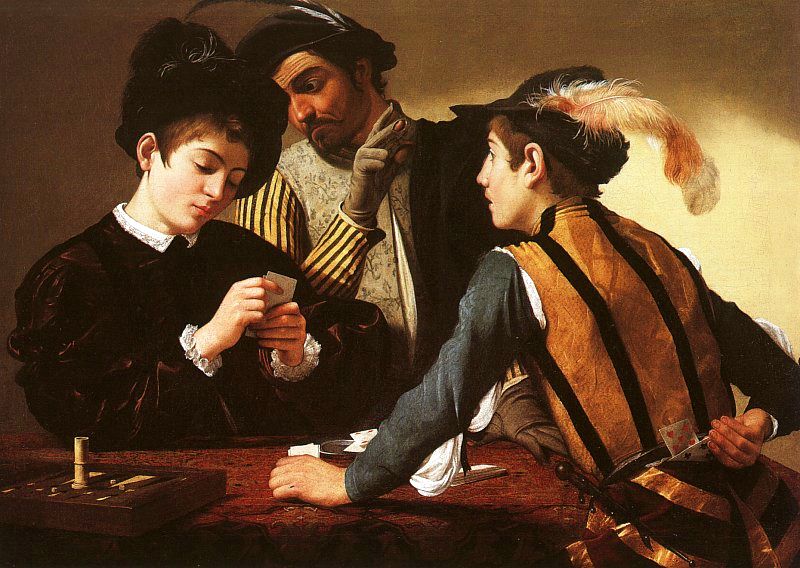
Smoke wafts about the seedy parlor. Potential hangs with it in the air as a boy, full of the elite’s self-assured pomposity, shuffles through his cards, his delicate eyes giving their full attention to the game, oblivious to the trickster behind him. The painting captures the moment before the trap springs, as old Loki motions “Get ready” with his two fingers, unintentionally spread in the Christian gesture normally attributed to Jesus in Byzantine art, and his young apprentice grasps the replacement cards hidden behind his back.
One of Caravaggio's first works after leaving the employ of Cavaliere Giuseppe Cesari d'Arpino, Cardsharps is a clear attempt to establish an individual style. Where before he had been forced to finish the details on very standard fare for d'Arpino (Keith Christiansen, 2000), now he strikes out boldly at the genre painting. As with Boy Peeling Fruit, the detail is precise. Note the sliced finger on the old man's glove, the intricate table cloth, the board of backgammon balancing the piece, and the way every wrinkle of cloth on all three of the subjects crinkles so realistically it could be pulled from a photograph. But also in common with Boy Peeling Fruit is a sense of ambiguity. An emphasis on the thoughts of the characters, and a question of what exactly those thoughts are. The rich boy looks at his cards, the pensive expression so concentrated on his face a mixture of careless disdain and deep desire for victory. The old trickster's expression is harder to read: the surprised eyebrows, the mouth pursed in an "Ehh, not so bad," the wide eyes suggesting a hint of fear. And the young cardsharp is most interesting of all. He looks to his master, clearly nervous, but he grips his trick cards readily, excited for the mark to be hit. The complexity under the surface pulls us in. The bright sunlight from the top left illuminates the scene, just as the complexity of the figured within it throws the event into doubt.

No comments:
Post a Comment