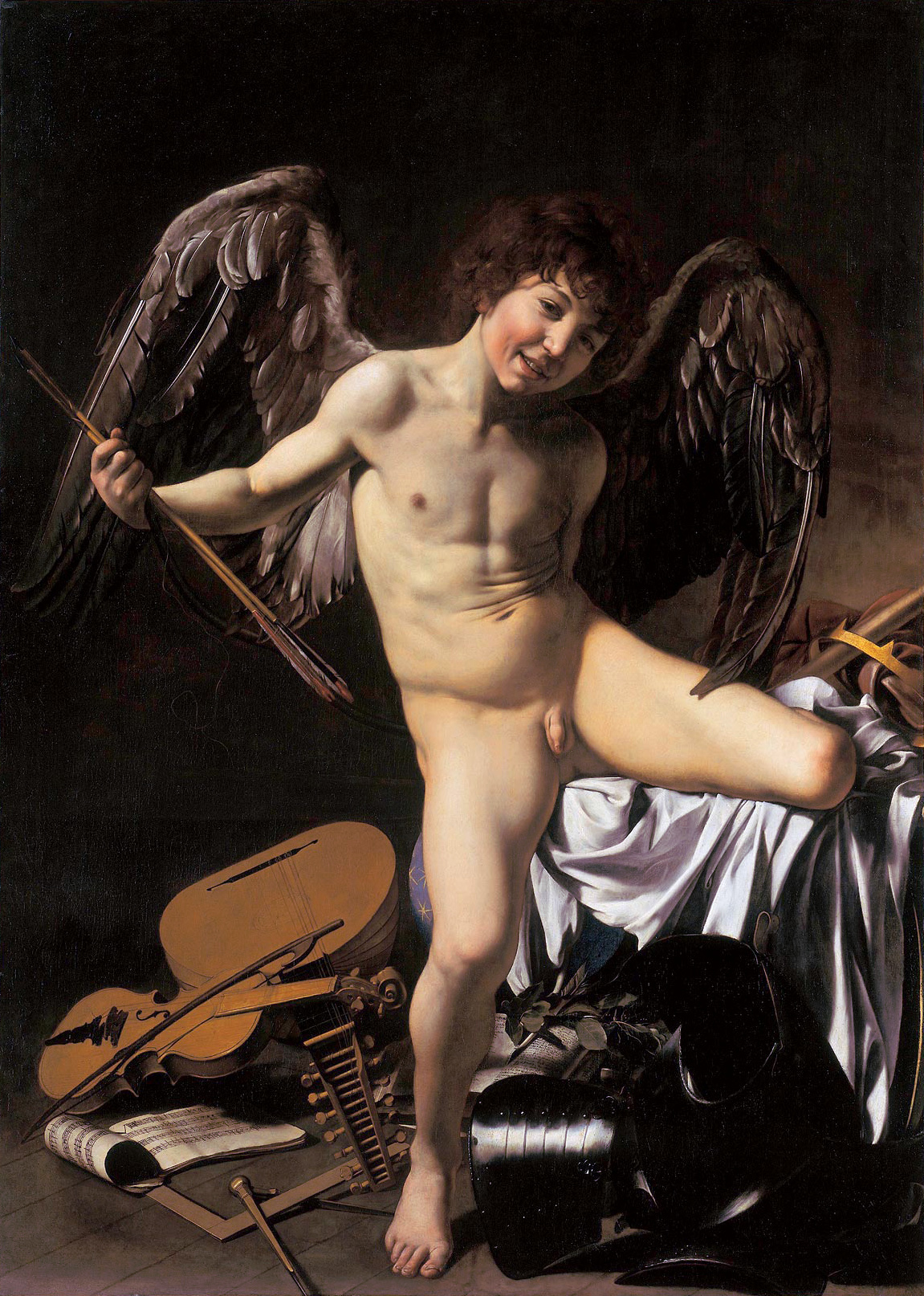
Amor Victorious gets in one's face, to say the least. At first glance, Cupid seems to be dancing a violent, joyful jig. Arrows clutched tightly in one hand, bicep flexed, the look of satisfaction upon Cupid's face comes across as disdainful. Closer examination shows that the left leg rests on a ruined table. The cloth is ruffled, a crown languishes on disorganized pillows. To the left and below, all manner of human sophistication lies in tatters: a violin and bow discarded on the floor, armor glints upwards, abandoned. A lyre, a music book, leafy branches, and implements of mathematics fill in the spaces.
I read this painting in two contradicting ways: either love is the ally of humanity, or love is victorious over it. To the first: all of man's achievements are united by Caravaggio into one maelstrom, in the middle of which stands our personification of love, his arms holding the sharp ends of arrows away from humanity, his legs seeming to meld into the scene. But I find the second meaning more likely, because there's something just not right about Cupid. Though he's youthful, he isn't pure, or plump, or mischievous, like he was traditionally painted. His smile is mean, his wings, normally angelic, are soot black. The only things he touch, the arrows, suggest war. Everything else lies beneath him, defeated. Much about Amor Victorious makes the viewer slightly uncomfortable, but nothing more so than Cupid's penis. Not to be crass, but it is a focal point of the painting, isolated from the surrounding more complex areas, with the visual arrows of the actual arrows, violin bow, both legs, the curve of the pelvis and line of the table, the shadowing, an implied line down Cupud's sternum, and one of his wings, that twists onto his leg, all diverting the viewer's eye straight to it. Though nudes of young boys were common in the Renaissance, the special attention Caravaggio placed on Cupid's genitalia twists the meaning of Amor Victorious from pure, thoughtful love to a more carnal lust. Combined with the previously mentioned maliciousness in the painting, the mood becomes sinister, and confusing in traditional Caravaggio style.

No comments:
Post a Comment