Tuesday, February 15, 2011

Bibliography (2011)

Category. (n.d.). Foreshortening - What is Foreshortening. Drawsketch - Drawing Lessons and Tutorials. Retrieved February 14, 2011, from http://drawsketch.about.com/od/

Christiansen, K. (n.d.). Caravaggio (Michelangelo Merisi) (15711610) and his Followers | Thematic Essay | Heilbrunn Timeline of Art History | The Metropolitan Museum of Art. The Metropolitan Museum of Art, New York: metmuseum.org. Retrieved February 14, 2011, from http://www.metmuseum.org/toah/hd/cr

Halpern, Baruch (2004).  David’s Secret Demons.

Gash, John (2003). Caravaggio

Janick, J. (n.d.). Caravaggio's Fruit: A Mirror on Baroque Horticulture. Purdue. Retrieved February 14, 2011, from http://www.hort.purdue.edu/newcro


Nelson, R. (n.d.). Darkness & Light: Caravaggio and his World - ArtsReviews - www.theage.com.au. The Age - Business, World & Breaking News | Melbourne, Australia. Retrieved February 14, 2011, from http://www.theage.com.au/articl

Symbolism in Renaissance Art « Gina's Blog. (n.d.). Gina's Blog. Retrieved February 14, 2011, from http://philosopheress.wordpress.com/2010/01/10/symbolism-in-renaissance-art-2/

David with the Head of Goliath (1610)


With one of Caravaggio's final installments, the themes he's been working at his whole life come together.

Ambiguous Thought: We asked it with Boy Peeling Fruit, and every painting afterward: what's on the character's mind?  No matter who Caravaggio paints, their faces just seem to suggest more than what we see.  This question is brought to a head (pun very much intended) with David's expression as he gazes on the slain Goliath.  Looking at other depictions of David (by Michelangelo a century before, Orazio Gentileschi within decades, and even Caravaggio himself earlier in his career), the mood is exuberant.  A boy of youth and vigor holding aloft his prize.  But here there is pity written across David's face.  And he does not seem like a boy.  Though youthful in frame, his expression and the deep shadows cutting across his face produce the illusion of age.  And this makes sense, because a few years before Caravaggio made David with the Head of Goliath, he himself had committed murder.  There's an understanding of the complex emotions that result from the taking of a life in this painting.  Things get more complicated when one considers that this is a self portrait.

Brutal Honesty: Honest depiction of the world can be seen in Bowl of Fruit.  Honest depiction of character can also be viewed in The Calling of Saint Mathew.  In this latest painting, Caravaggio is brutally honest about himself.  The boy, David, is him.  The model he used was very likely Cecco del Caravaggio, his studio assistant from his time in Rome who was born in the painter's home town (Gash, 2003).  These connections to his own past suggest strongly that Caravaggio wanted to cast himself as the boy.  But we know from other self-portraits what he looked like as a man, and he clearly painted his present self as Goliath.  The struggle then becomes between an innocent spirit and a wretched, experience old man.  As Simon Schama puts it, this is "art without any vision of consolation."  Caravaggio strips away any suggestion of redemption for himself, or for his audience.  In order to defeat the vile monster he has become (one so ashamed that even in death his eyes are cast downwards), his innocent side must cut away the evil, and in doing so (we see clearly from David's expression) become tainted by it.  There is no victory, only honesty.

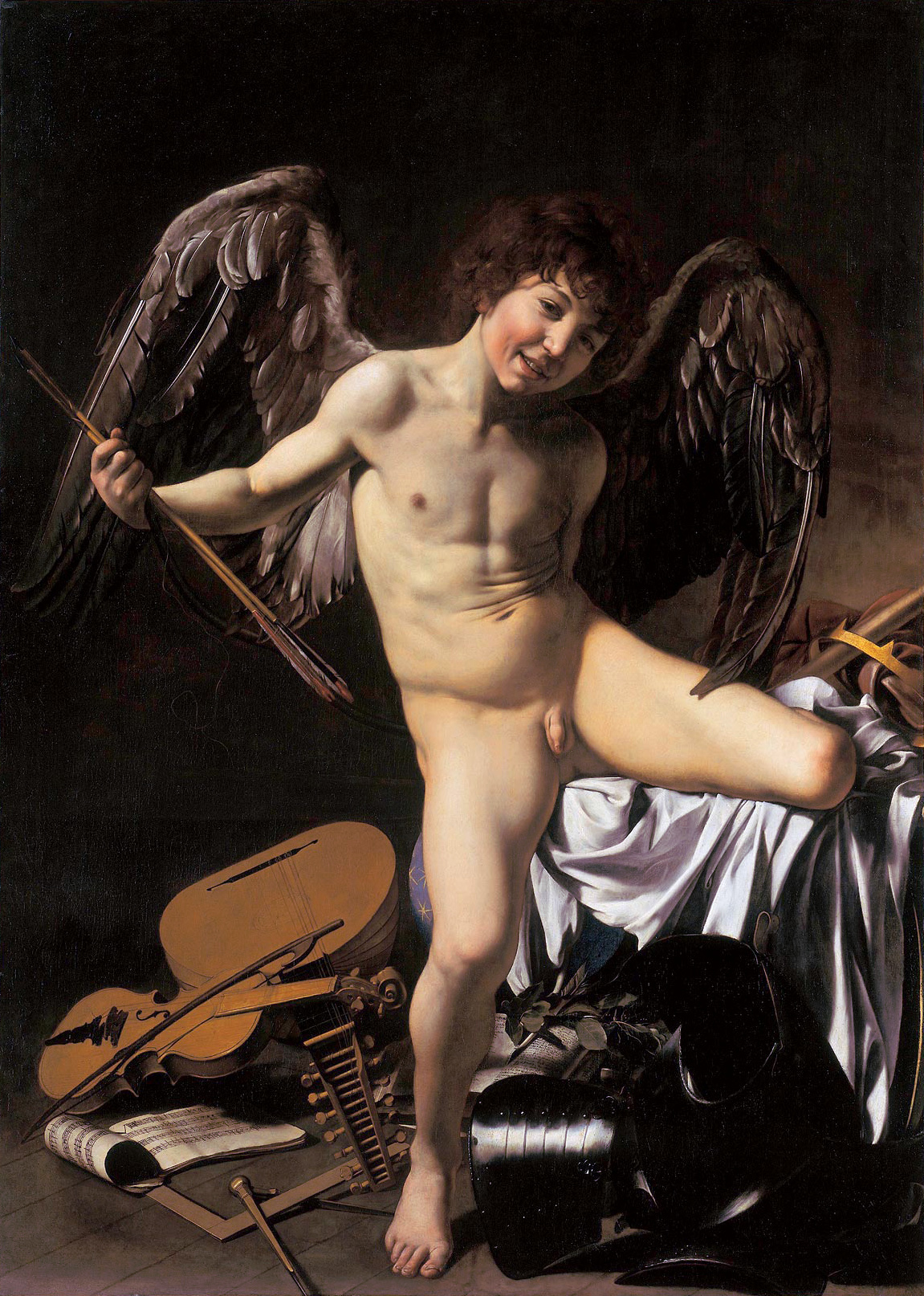
Amor Victorious (1602)


Amor Victorious gets in one's face, to say the least.  At first glance, Cupid seems to be dancing a violent, joyful jig.  Arrows clutched tightly in one hand, bicep flexed, the look of satisfaction upon Cupid's face comes across as disdainful.  Closer examination shows that the left leg rests on a ruined table.  The cloth is ruffled, a crown languishes on disorganized pillows.  To the left and below, all manner of human sophistication lies in tatters: a violin and bow discarded on the floor, armor glints upwards, abandoned.  A lyre, a music book, leafy branches, and implements of mathematics fill in the spaces.

I read this painting in two contradicting ways: either love is the ally of humanity, or love is victorious over it.  To the first:  all of man's achievements are united by Caravaggio into one maelstrom, in the middle of which stands our personification of love, his arms holding the sharp ends of arrows away from humanity, his legs seeming to meld into the scene.  But I find the second meaning more likely, because there's something just not right about Cupid.  Though he's youthful, he isn't pure, or plump, or mischievous, like he was traditionally painted.  His smile is mean, his wings, normally angelic, are soot black.  The only things he touch, the arrows, suggest war.  Everything else lies beneath him, defeated.  Much about Amor Victorious makes the viewer slightly uncomfortable, but nothing more so than Cupid's penis.  Not to be crass, but it is a focal point of the painting, isolated from the surrounding more complex areas, with the visual arrows of the actual arrows, violin bow, both legs, the curve of the pelvis and line of the table, the shadowing, an implied line down Cupud's sternum, and one of his wings, that twists onto his leg, all diverting the viewer's eye straight to it.  Though nudes of young boys were common in the Renaissance, the special attention Caravaggio placed on Cupid's genitalia twists the meaning of Amor Victorious from pure, thoughtful love to a more carnal lust.  Combined with the previously mentioned maliciousness in the painting, the mood becomes sinister, and confusing in traditional Caravaggio style.

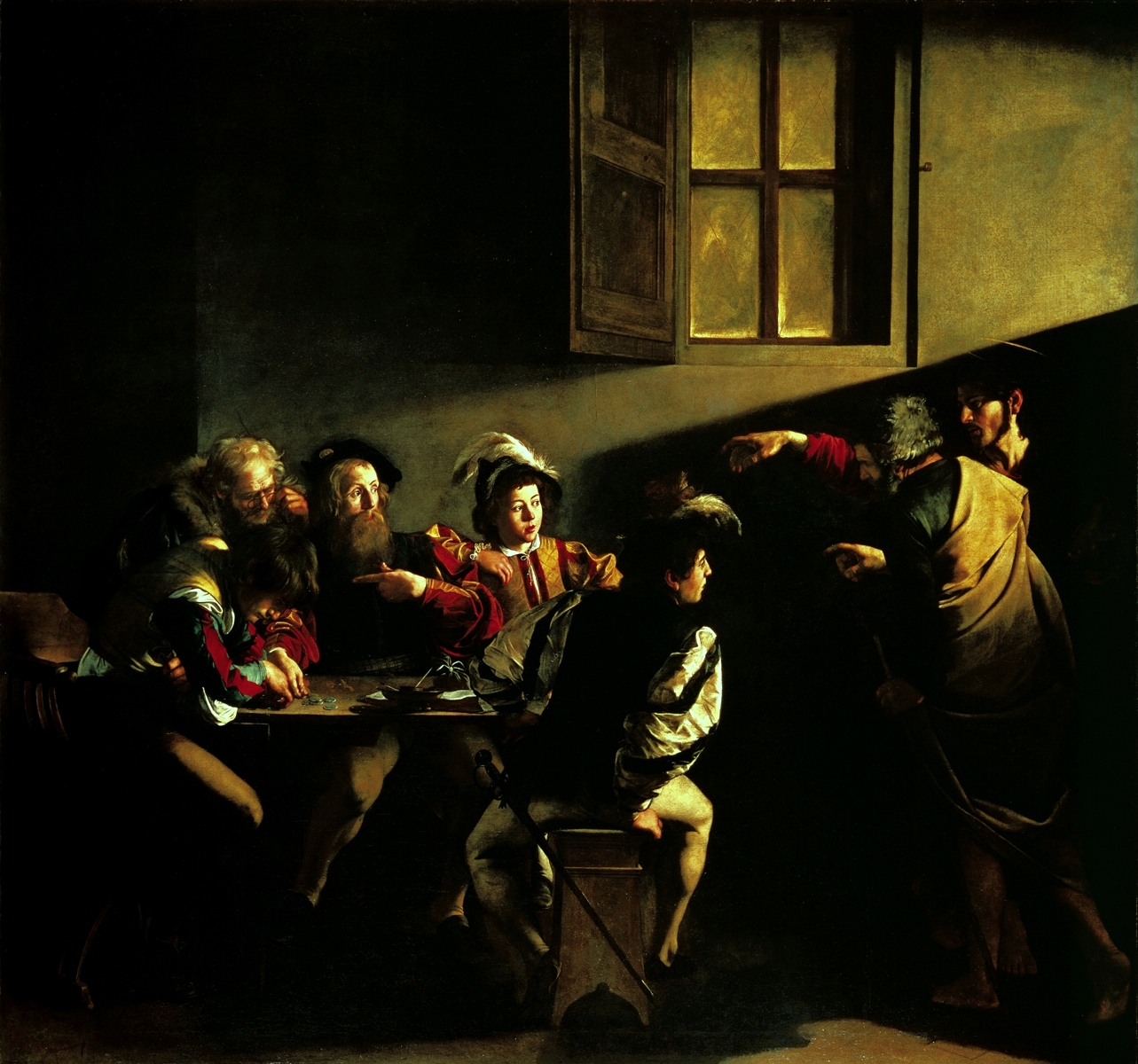
The Calling of St. Mathew (1600)


Jesus saw a man named Matthew at his seat in the custom house, and said to him, "Follow me", and Matthew rose and followed him. -Matthew 9:9

A hand raises from the darkness and seeks Mathew out among the sinners at the card table.  A cloaked figure, barely visible but for his bare feet and lean face, steps into the sunlight, just as it appears from behind a cloud.  All at once the scene becomes visible: five gamblers squabbling over pocket change like dogs over a carcass.  Two men are so engrossed with counting their pittance they fail to see the miracle.  Another two, younger, glance up but do not understand what is happening.  It is only Mathew, clothed in a black robe now starkly contrasting against the heavenly light, who understands.  Me?

With this painting and it's sibling, The Martyrdom of Saint Mathew, Caravaggio was hired to depict a story, the life and death of the saint. The assignment is very Gothic in nature: to clearly portray a biblical tale so that the common can grasp it.  We have seen with Boy Peeling Fruit and Basket of Fruit that Caravaggio excels at upturning tradition, and here he does it yet again.  Besides the update in technical style, the thing that separates this painting from Gothic work is the focus on character, and specifically which character is focused on.  Jesus stands in shadow, and St. Mathew is highlighted.  The visual arrows of hands pointing and light flowing all lead straight to Mathew.  We see not Jesus, but what Jesus would have seen.  He said to the Pharisees that "I have not come to call the righteous, but sinners to repentance," and the sinners are exactly what Caravaggio gives us, in all their sticky glory.

But what makes this my favorite painting of Caravaggio's is the lighting.  I showed the artist discovering light, and then replicating it, and then fabricating it in his earlier works, and now Caravaggio lets his knowledge loose.  The golden, heavenly light that floods the scene does not come from the window taking us important space on the wall.  In fact, the panes of glass show a gloomy, relatively dark world outside.  This makes the light streaming in right to left seem all the more magical.  It also behaves uniquely in many ways.  Just before the first boy's face, for example, the lighting drops half a foot to brighten his features.  Similarly, though Jesus stands in the way of the light, he remains completely dark while those farther away are bathed.  And as with the majority of Caravaggio's work, the light source remains ambiguous.  It's shone as coming from up high, but illuminates the lowest parts of the foreground.  Through all of these inconsistencies, Caravaggio creates in us a sense of wonder.  The light seems so real, it interacts with surfaces just the way it ought to, casts perfect shadows, and shows the world realistically, but there's such an intelligence behind it, the way Jesus's hand directionalizes it, how an it be from the sun?

Sunday, February 13, 2011

Basket of Fruit (1599)


Still lifes, and especially bowls of fruit, are traditionally a way for artists to show their skill.  Look at what I can do, my sense of detail, my understanding of form and texture.  Caravaggio's showing off in this painting too, but in a much more complex manner.  Basket of Fruit summed up his philosophy on painting reality in a way no previous work of his had.  The decay is key.  Up to this point in the Renaissance, art had unquestionably been about depicting perfection.  From Michelangelo's David, to the Hellinistic statues littering Rome, to every painting commissioned by the Church up to that time, the Form (and I mean that in the way Plato did, of To Kalon, of the hypothetically perfect version of everything to which we all strive) of the subject was the clear aim.  Caravaggio says no with Basket of Fruit, and he says it with rot, and welts, and imperfection.  Again, the light source is is powerful and diffuse, and it revealed withering leaves searching for sunlight.  An apple blemishing from bug damage, sitting on dried out grapes which brush against a trail of pear leaves languishing to the floor.  The perfect painting is not a depiction of perfection, Caravaggio seems to be saying, it is a believable depiction of life and death.  Of decay.

The Lute Player (1596)


With The Lute Player, I'd like to discuss Caravaggio's methodology.  Though he wasn't the first painter to work from live models, he was the most insistent, and his results were the most true (if not to the reality he painted, then to the laws of the universe) that had yet been made.  To wit:

Caravaggio took his models from the streets.  Peasants, prostitutes, people he could pay a pittance to stand for weeks on end so he cold get every detail just right.  In The Lute Player, his scientific observation can be seen in the translucence of the boy's music sheet, the way it brightens at reflected light from the paper below.  Reflected light.  For goodness sake, this is the 1500s we're talking about!  The glint off the instruments is carefully documented, as is the complex shadowplay along the boy's left arm.  As with Boy Peeling Fruit, the dark background creates high contrast and... come to think of it, why is the background so dark?  If Caravaggio was as obsessed with detail as he seems here, how could he have painted a black background when he was clearly using such a strong and diffuse light source.  It's the same in Boy Peeling Fruit, and in Saint Francis in Meditation, Sacrifice of Isaac, David and Goliath, John the Baptists (1600), Crucification of  Saint Peter, and so many other of the painter's most stunningly apparently true to life works.  The fact is he wasn't painting real light, couldn't have been, he was making it up.  And doing it so realistically that we aren't even bothered.  His method of high contrast figure-ground relationships was something all together new in Rome.  Robert Nelson, of theage.com, writes that "Caravaggio neither invented dark, contrasty painting nor directional light nor realism nor daily life in art nor ordinary folk in religious painting" (2004).  But he combined them in a manner no painter had before him, because no previous painter working solely from live models could have, because no single live image could capture everything Caravaggio's paintings clearly do.  The dark backgrounds, the high contrast figures, the realism, and the celebration and damnation of street life, all were a result of Caravaggio's unique methodology.

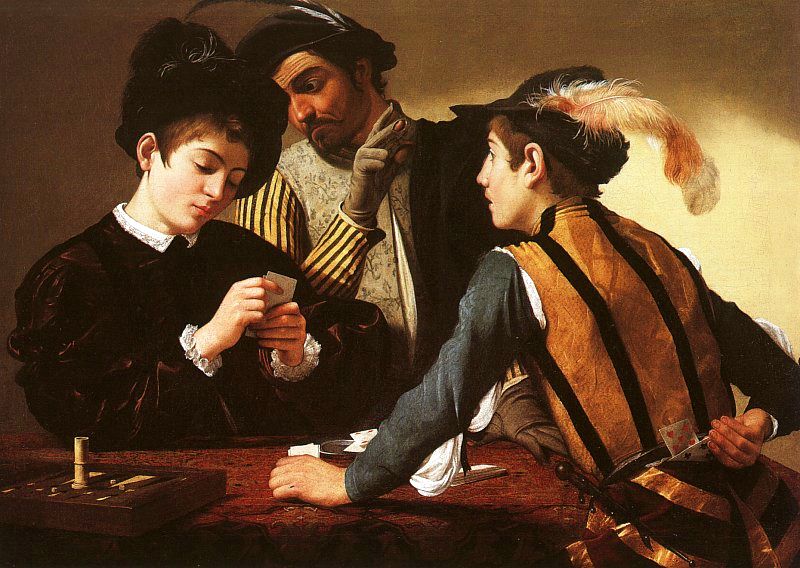
Cardsharps (1594)


Smoke wafts about the seedy parlor.  Potential hangs with it in the air as a boy, full of the elite’s self-assured pomposity, shuffles through his cards, his delicate eyes giving their full attention to the game, oblivious to the trickster behind him.  The painting captures the moment before the trap springs, as old Loki motions “Get ready” with his two fingers, unintentionally spread in the Christian gesture normally attributed to Jesus in Byzantine art, and his young apprentice grasps the replacement cards hidden behind his back.

One of Caravaggio's first works after leaving the employ of Cavaliere Giuseppe Cesari d'Arpino, Cardsharps is a clear attempt to establish an individual style.  Where before he had been forced to finish the details on very standard fare for d'Arpino (Keith Christiansen, 2000), now he strikes out boldly at the genre painting.  As with Boy Peeling Fruit, the detail is precise.  Note the sliced finger on the old man's glove, the intricate table cloth, the board of backgammon balancing the piece, and the way every wrinkle of cloth on all three of the subjects crinkles so realistically it could be pulled from a photograph.  But also in common with Boy Peeling Fruit is a sense of ambiguity.  An emphasis on the thoughts of the characters, and a question of what exactly those thoughts are.  The rich boy looks at his cards, the pensive expression so concentrated on his face a mixture of careless disdain and deep desire for victory.  The old trickster's expression is harder to read: the surprised eyebrows, the mouth pursed in an "Ehh, not so bad," the wide eyes suggesting a hint of fear.  And the young cardsharp is most interesting of all.  He looks to his master, clearly nervous, but he grips his trick cards readily, excited for the mark to be hit.  The complexity under the surface pulls us in.  The bright sunlight from the top left illuminates the scene, just as the complexity of the figured within it throws the event into doubt.