Jesus saw a man named Matthew at his seat in the custom house, and said to him, "Follow me", and Matthew rose and followed him. -Matthew 9:9
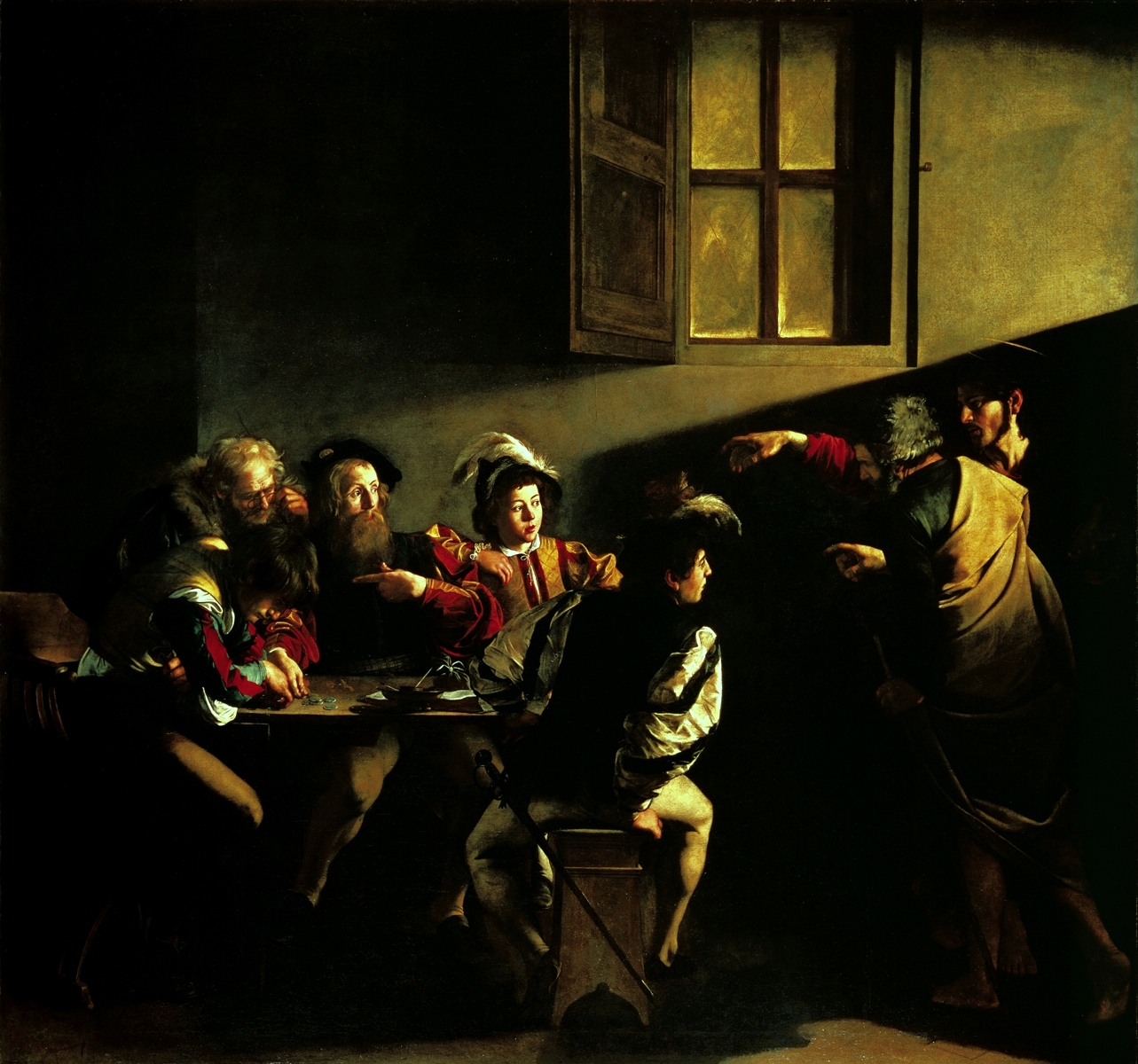
A hand raises from the darkness and seeks Mathew out among the sinners at the card table. A cloaked figure, barely visible but for his bare feet and lean face, steps into the sunlight, just as it appears from behind a cloud. All at once the scene becomes visible: five gamblers squabbling over pocket change like dogs over a carcass. Two men are so engrossed with counting their pittance they fail to see the miracle. Another two, younger, glance up but do not understand what is happening. It is only Mathew, clothed in a black robe now starkly contrasting against the heavenly light, who understands. Me?
With this painting and it's sibling, The Martyrdom of Saint Mathew, Caravaggio was hired to depict a story, the life and death of the saint. The assignment is very Gothic in nature: to clearly portray a biblical tale so that the common can grasp it. We have seen with Boy Peeling Fruit and Basket of Fruit that Caravaggio excels at upturning tradition, and here he does it yet again. Besides the update in technical style, the thing that separates this painting from Gothic work is the focus on character, and specifically which character is focused on. Jesus stands in shadow, and St. Mathew is highlighted. The visual arrows of hands pointing and light flowing all lead straight to Mathew. We see not Jesus, but what Jesus would have seen. He said to the Pharisees that "I have not come to call the righteous, but sinners to repentance," and the sinners are exactly what Caravaggio gives us, in all their sticky glory.
But what makes this my favorite painting of Caravaggio's is the lighting. I showed the artist discovering light, and then replicating it, and then fabricating it in his earlier works, and now Caravaggio lets his knowledge loose. The golden, heavenly light that floods the scene does not come from the window taking us important space on the wall. In fact, the panes of glass show a gloomy, relatively dark world outside. This makes the light streaming in right to left seem all the more magical. It also behaves uniquely in many ways. Just before the first boy's face, for example, the lighting drops half a foot to brighten his features. Similarly, though Jesus stands in the way of the light, he remains completely dark while those farther away are bathed. And as with the majority of Caravaggio's work, the light source remains ambiguous. It's shone as coming from up high, but illuminates the lowest parts of the foreground. Through all of these inconsistencies, Caravaggio creates in us a sense of wonder. The light seems so real, it interacts with surfaces just the way it ought to, casts perfect shadows, and shows the world realistically, but there's such an intelligence behind it, the way Jesus's hand directionalizes it, how an it be from the sun?

No comments:
Post a Comment